



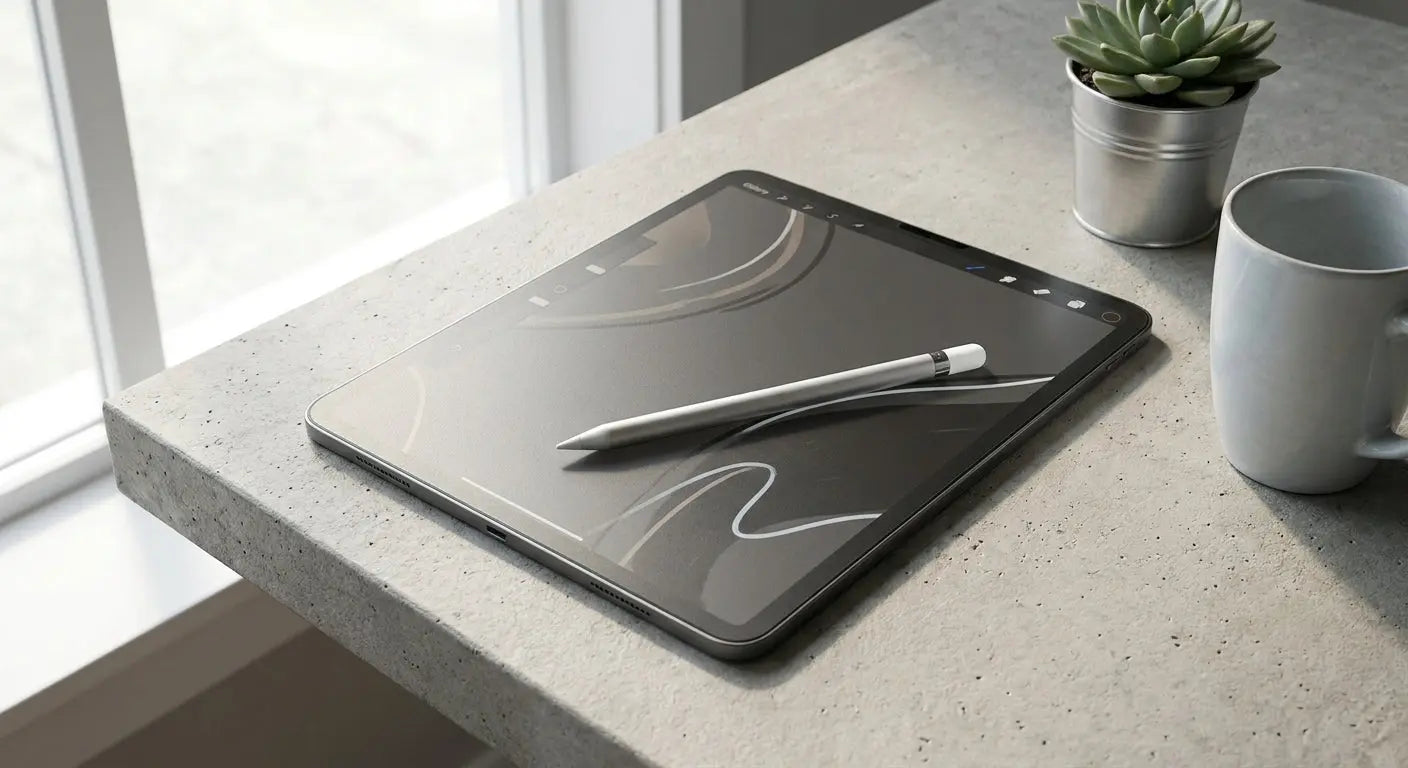
The Wrong Screen Protector Can Cost You More Than You Think
You've spent ₹60,000 or more on an iPad. The case gets careful consideration. The Apple Pencil gets its own line item. But the screen protector? Most buyers grab whatever's cheapest and move on.
That's a mistake. The two dominant options, paper-feel PET film (often called PaperType or paperlike) and tempered glass, aren't interchangeable. Each comes with hidden costs: accelerated Apple Pencil nib wear, display quality trade-offs, and long-term replacement expenses that add up quietly.
This guide gives you a use-case-driven framework so you can match the right protector to how you actually use your iPad — the latest iPad Air M4, iPad Pro M5, or the standard iPad A16.
What Is a PaperType Screen Protector?
A PaperType (or paperlike) screen protector is a textured PET film engineered to replicate the grain of real paper. The surface creates controlled friction under the Apple Pencil tip, so writing and sketching feel natural rather than slippery. If you've ever tried to take handwritten notes on bare iPad glass, you know the difference immediately.
Beyond writing feel, paper-feel protectors offer practical anti-glare and anti-fingerprint properties. For anyone using an iPad outdoors or in a brightly lit Indian classroom, that matte finish cuts reflections significantly. Your screen stays readable even under direct sunlight.
The trade-off is display quality. PET film reduces screen clarity and introduces slight colour desaturation. On an OLED iPad Pro M5, where deep blacks and accurate colours are a headline feature, that haze becomes noticeable — a real compromise for users who also watch movies or edit photos on the same device.
Consumer interest in this category is climbing fast. Search volume for paper-feel iPad Air protectors jumped over 20% week-over-week in April 2026, reflecting how seriously note-takers and artists are taking this decision.
One more consideration: the rougher PET texture accelerates Apple Pencil nib wear. Heavy daily users (five-plus hours of drawing or note-taking) may find themselves replacing nibs every four to six months, compared to roughly once a year on glass. That's an ongoing cost most product listings won't mention upfront.
What Is a Tempered Glass Screen Protector?
Tempered glass screen protectors are made from reinforced glass that has been heat-treated for impact resistance. The surface is smooth and optically clear, preserving the iPad's original display experience almost exactly as Apple intended.
This category dominates the market for good reason. Tempered glass accounts for roughly 90.6% of global screen protector revenue by material. It's the default choice, and for media-focused users, it's the right one. Colour accuracy, brightness, and contrast all remain intact, which matters enormously on the iPad Pro M5's OLED panel.
For Apple Pencil users, the smooth glass surface means less friction. Occasional note-takers won't mind this at all. But daily illustrators and calligraphers often find the slippery feel frustrating, especially during long sessions.
The practical downsides are real. Glossy glass reflects light aggressively and shows every fingerprint. If you're a student using your iPad in a bright classroom or outdoors in Indian sunlight, you'll spend more time adjusting your screen angle than you'd like.
Head-to-Head: The Key Trade-Offs
Here's how the two types compare across the five dimensions that matter most:
Writing Feel: PaperType wins. The textured surface mimics paper friction, giving Apple Pencil strokes a natural drag. Tempered glass feels slippery by comparison, which can reduce precision for handwriting and detailed illustration work.
Display Clarity: Tempered glass wins. It preserves the full colour accuracy and brightness of your iPad's screen, including the deep blacks and wide colour gamut of OLED panels. PaperType's matte texture introduces a visible haze and slight colour desaturation.
Impact Protection: Tempered glass wins decisively. PET film offers minimal drop or scratch protection. Some glass-based paper-feel hybrids offer up to five times the impact absorption of standard matte PET film. If physical protection is a priority, glass is the clear answer.
Apple Pencil Nib Wear: Tempered glass wins again. PET film's abrasive texture grinds down nibs faster. In India, a 4-pack of Apple Pencil replacement nibs costs approximately ₹1,600. For heavy users replacing nibs two to three times a year instead of once, that's an extra ₹1,600 to ₹3,200 annually.
Anti-Glare and Outdoor Use: PaperType wins. The matte finish dramatically reduces reflections, making it the better choice for bright environments. Glossy tempered glass turns into a mirror under direct sunlight.
The Hidden Cost Most Buyers Ignore: Apple Pencil Nib Wear
This deserves its own spotlight because it's the most overlooked factor in the decision. A paper-feel PET film's textured surface acts like fine sandpaper on your Apple Pencil tip. Heavy daily users — illustrators, GoodNotes power users, architecture students — can burn through a nib in four to six months. On tempered glass, that same nib lasts roughly a year.
At ₹1,600 for a 4-pack of replacement nibs, the costs accumulate. Over two years of heavy use with a PET protector, you could spend ₹3,200 to ₹4,800 on nibs alone. That's nearly the cost of two or three screen protectors.
Matte tempered glass hybrids use micro-etching rather than a rough PET surface, creating a gentler texture that's easier on nibs. Even the Paperlike brand acknowledges that their protector causes wear, though they describe it as "negligible over an extended period." For light users, that's accurate. For someone drawing five hours a day, the difference is real and measurable.
Factor nib replacement into your total cost of ownership, especially if you're a price-sensitive buyer.
Which iPad Model Should Guide Your Choice?
iPad Pro M5 (for professionals and creatives): The OLED display is the star feature here. Covering it with a hazy PET film undercuts the very thing you paid a premium for. Tempered glass is strongly recommended. If you draw daily and can't give up the paper feel, look into matte glass hybrids rather than standard PET film. You'll get closer to that paper texture without sacrificing as much display quality.
iPad Air M4 (for students and note-takers): Widely regarded as the best student iPad for 2026, the Air M4 pairs well with a paper-feel protector if your primary workflow revolves around GoodNotes, Notability, or Procreate. The LCD panel is less sensitive to the matte haze than an OLED screen. For students who primarily consume media and take occasional notes, tempered glass remains the more versatile pick.
Standard iPad A16 (for casual users and families): Tempered glass is the practical default here. Most users in this category don't use the Apple Pencil intensively enough to justify the display and nib-wear trade-offs of a paper-feel protector. Glass gives you solid protection and a clean viewing experience.
Multi-device Apple households: If you're already protecting an iPhone, MacBook, or Apple Watch, choosing a brand with model-specific compatibility across the full Apple ecosystem simplifies the process. Moarmouz offers precision-fit protectors for every current Apple device, so you can sort out the entire household in one order.
A quick note on Apple Pencil compatibility: Apple Pencil Pro (USB-C) and 2nd Gen work with newer iPads, while the 1st Gen pairs with older models. Your screen protector choice applies equally across all Pencil generations.
The Third Option: Magnetic Detachable Paper-Feel Protectors
There's a growing category that refuses to pick a side. Magnetic detachable paper-feel protectors snap onto your iPad screen when you want the paper texture for writing or drawing, then lift off cleanly when you switch to video, gaming, or photo editing.
The concept is genuinely clever. You get the tactile writing feel of a PaperType protector during work sessions and the full display clarity of bare glass (or a tempered glass base layer) for everything else. It's the closest thing to having both without compromise.
There's also a sustainability angle worth considering. Traditional PET film protectors are single-use and non-recyclable. A reusable magnetic protector lasts longer and generates less waste, something that resonates with younger, environmentally conscious buyers.
The trade-offs are practical. The upfront cost is higher, and the daily workflow involves physically attaching and removing the protector. If you want a set-and-forget solution, this isn't it. For mixed-use iPad owners who split their time between note-taking and media consumption, though, it's the premium choice that skips the compromises entirely.
Your Quick Decision Guide: Which One Is Right for You?
Four user profiles, four clear recommendations:
- The Digital Artist or Daily Note-Taker (5+ hours of Apple Pencil use daily): Choose a PaperType protector or a matte glass hybrid. The writing feel is non-negotiable for your workflow. Budget an extra ₹1,600 to ₹3,200 per year for nib replacements if you go with PET film.
- The Media Consumer and Gamer: Choose tempered glass. Colour accuracy, brightness, and smooth touch response matter most for your use case. Don't sacrifice display quality for a feature you'll rarely use.
- The Student Using iPad Outdoors or in Bright Classrooms: Choose PaperType or matte glass. Anti-glare performance is the priority when you're working under India's sunlight. Reduced reflections protect both your eyes and your productivity.
- The Mixed-Use Professional (writing + media + video calls): Choose a magnetic detachable paper-feel protector or a matte tempered glass hybrid. You need versatility, and these options deliver it without locking you into a permanent trade-off.
This is a use-case decision, not a quality decision. Both PaperType and tempered glass are excellent products when matched to the right user. The wrong choice isn't the "worse" product — it's the one that doesn't fit how you actually use your iPad.
Protect Your iPad the Right Way — Tried, Tested, Trusted
The core decision is straightforward. Paper-feel for writers and artists. Tempered glass for media lovers and clarity seekers. Magnetic hybrid for professionals who refuse to compromise.
At Moarmouz, we've been building precision-fit Apple accessories since 2014, long before most brands in India entered the space. Our screen protectors are designed for specific iPad models, including the iPad Air M4, iPad Pro M5, and every current iPad in the lineup. That model-specific approach is why publications including ANI News, Aaj Tak, The Hindu Business Line, and Business Standard have featured our work.
Every order above ₹999 ships free across India, and every product comes backed by our warranty support. If a friend needs the same recommendation, our refer-a-friend programme gives you both a discount.
Find the right screen protector for your exact iPad model. Explore the Moarmouz iPad screen protector range and get it sorted — your ₹60,000+ investment deserves more than a guess.
Share:
Texture Screen Protector Guide for Better Grip and Clarity
Paper Like Screen Protector: Benefits and Fit Guide